

Leo Tolstoy — The Innocence of Childhood and the Courage to Become Better
A journey through memory, sensitivity and the search for what makes us deeply human.
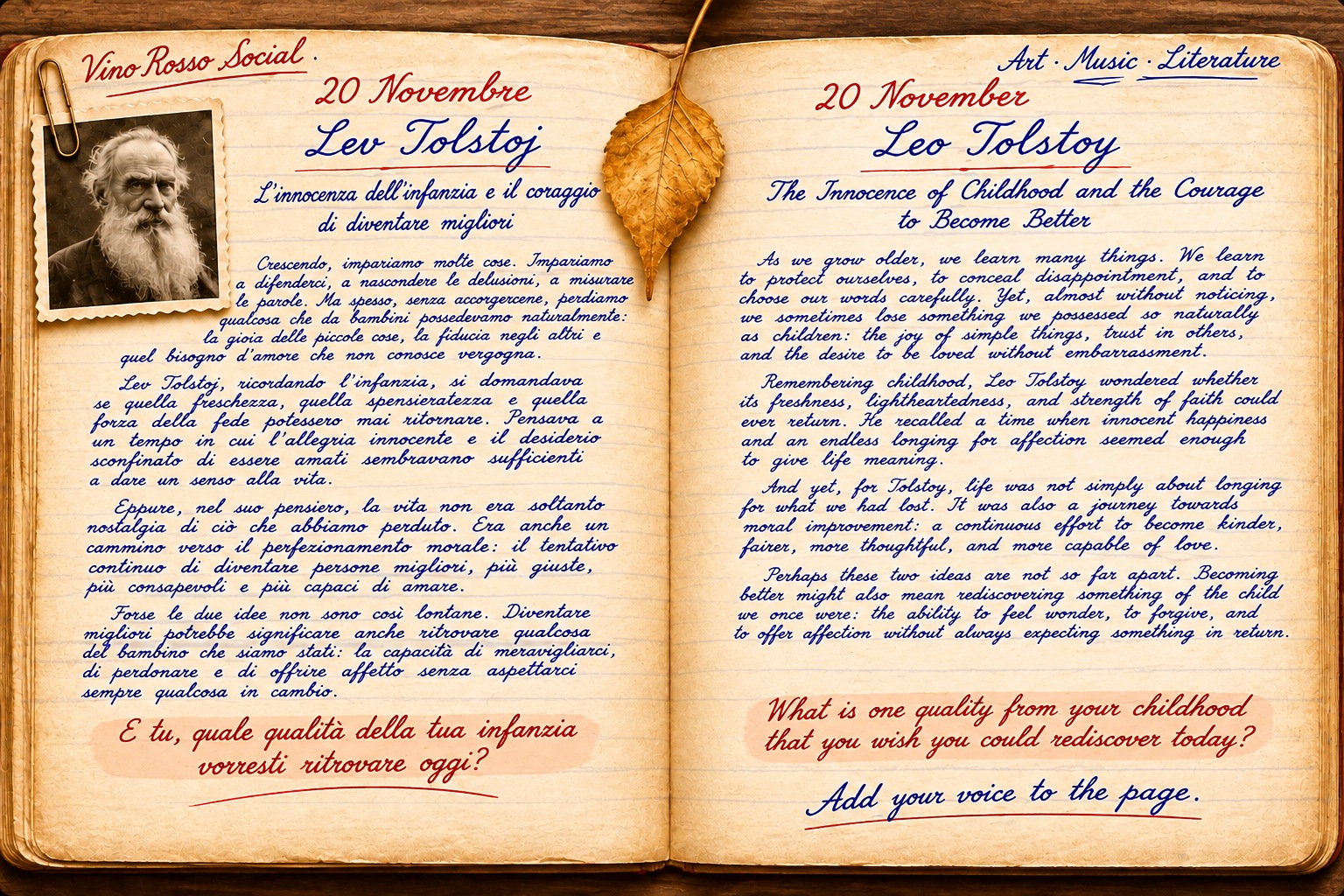
Leo Tolstoy
The Innocence of Childhood and the Courage to Become Better
As we grow up, we learn to understand the world, to face difficulties and to protect ourselves from disappointment. Yet along the way we risk losing something precious: spontaneity, trust in others and that sense of wonder that made even the simplest moments extraordinary.
Leo Tolstoy, one of the great figures of Russian literature, explored the world of childhood and the complexity of human feelings with remarkable sensitivity. In his novel Childhood, published in 1852, memories, affection and first disappointments become part of a journey of self-discovery.
In his view of life, growing up does not simply mean gathering experiences, but also questioning who we are and who we might become. Moral improvement grows from the ability to recognise our own mistakes, to understand others and to cultivate more genuine feelings.
Perhaps true maturity lies precisely here: keeping the wisdom gained over the years without giving up the sensitivity of the child we once were.
Childhood, with its emotions and memories, belongs to every culture. Languages, places and traditions change, but the longing for affection, the joy of discovery and the need to feel loved unite human beings far beyond any border.
Rediscovering something of our childhood can still help us become better people.
What is one quality from your childhood that you wish you could rediscover today?
Add your voice to the page.
Read Tolstoy’s works for free: Vino Rosso Library →
War and Peace · Sergei Bondarchuk, 1966–67
From the novel to the screen: discover War and Peace, the great film adaptation of Leo Tolstoy’s work. Watch the first part for free on the official Mosfilm channel.
Watch the film for free ↗Official Mosfilm video on YouTube · Part I, 2 h 27 min · subtitles available in the player